

Supporting Asia's clean energy future
The power sector contributes to 40% of global emissions1, making it a pivotal player in combatting climate change and enabling the global energy transition. At Sembcorp, we are committed to supporting Asia’s shift to a clean and responsible energy future for all.
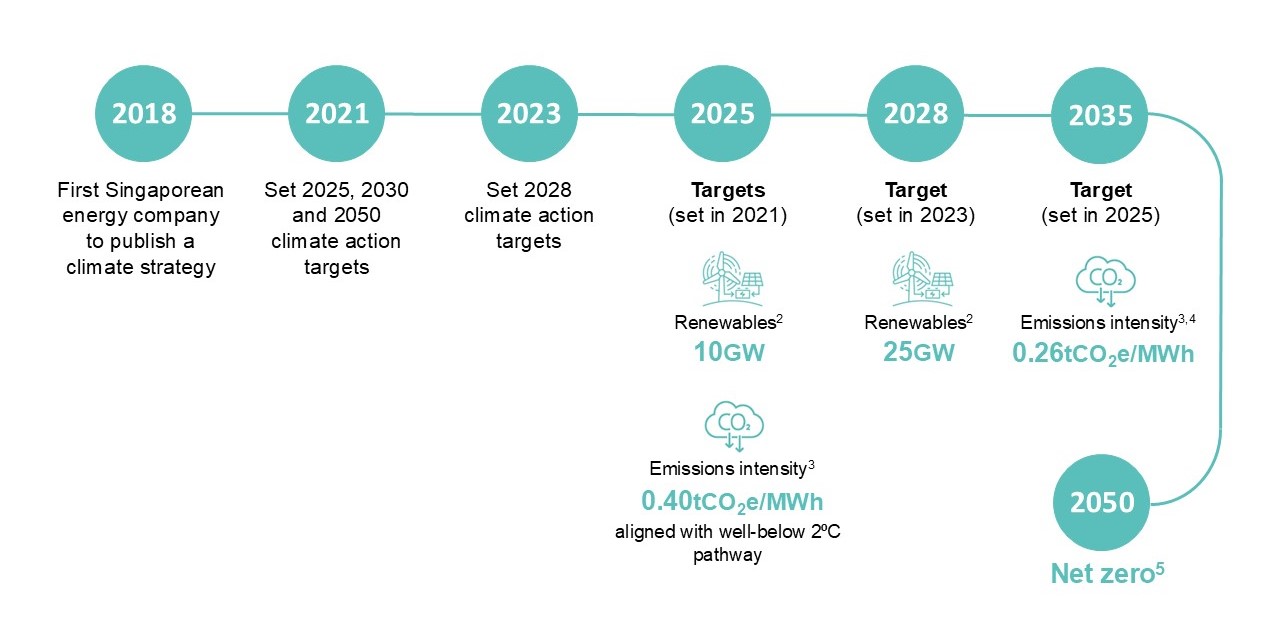
Sembcorp launched its climate change strategy in 2018 and unveiled our inaugural strategic plan in 2021. Since then, we have made significant progress against our 2025 strategic targets, with current gross installed renewables capacity of 20.2GW as at 12 November 2025. We have also achieved our 2025 emissions intensity target in 2023. We remain committed to achieving our net zero emissions target (Scope 1 and 2) by 2050.
In 2023, in light of the progress we made against our targets, we announced updated targets of 0.15tCO₂e/MWh emissions intensity and 25GW renewables capacity by 2028, retaining the absolute emissions target of 2.7 million tCO₂e by 2030. On December 11, 2025, Sembcorp Industries announced a proposed acquisition of Alinta Energy. For more information, please refer to the Alinta Energy acquisition announcement here. In view of this acquisition, Sembcorp expects its emissions to increase in the near term before declining. As such, Sembcorp will not meet its 2028 emissions intensity and 2030 absolute emissions targets. Our emissions intensity target has been updated.
Our targets
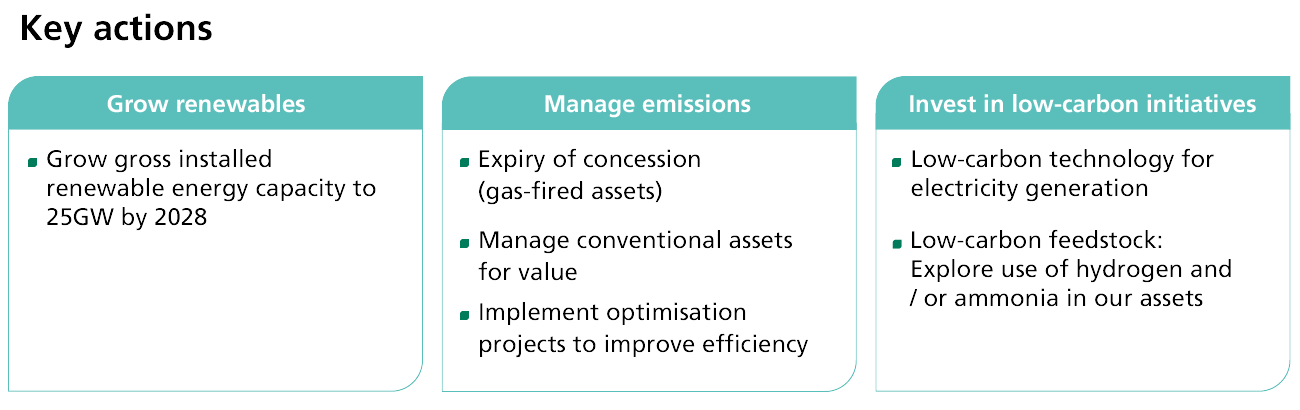
- By 2028, grow gross installed renewables capacity to 25GW
- By 2035, achieve emissions intensity3,4 of 0.26tCO₂e/MWh
- By 2050, deliver net-zero emissions5
The 2035 target adopts our existing 2023 base year. Our base year emissions have been re-baselined to account for emissions arising from the Proposed Acquisition and other acquisitions, divestments and concession expiry referencing the Greenhouse Gas Protocol standard on base year recalculation.
Navigating the energy transition journey
The journey from brown to green holds its own set of operational challenges, particularly in markets that are deeply entrenched in fossil fuel infrastructure and long-term supply agreements. To scale down fossil fuel usage, access to reliable and affordable renewable energy as well as low-carbon feedstock must be expanded to meet the needs of industry and individuals.
Sembcorp is taking significant steps to position itself as a key player in the journey towards a low-carbon future. As a leading renewables player in Asia, we are expanding our renewable energy portfolio to support the transition towards a net-zero future. In addition, we are actively exploring and investing in energy storage and battery technology to support the continued growth of renewables deployments.
During this critical phase of transition, secure, low-cost and efficient baseload power remains indispensable in upholding the energy security required by businesses and communities every day. As countries seek to decarbonise, baseload power remains the most accessible and critical for electricity while new renewables capacity is being developed.
Sembcorp remains committed to exploring low-carbon alternatives to gas. We will continue to invest in the necessary capabilities in production and turbine-firing of hydrogen and its derivatives, in anticipation of its future commercial viability and technological maturity.
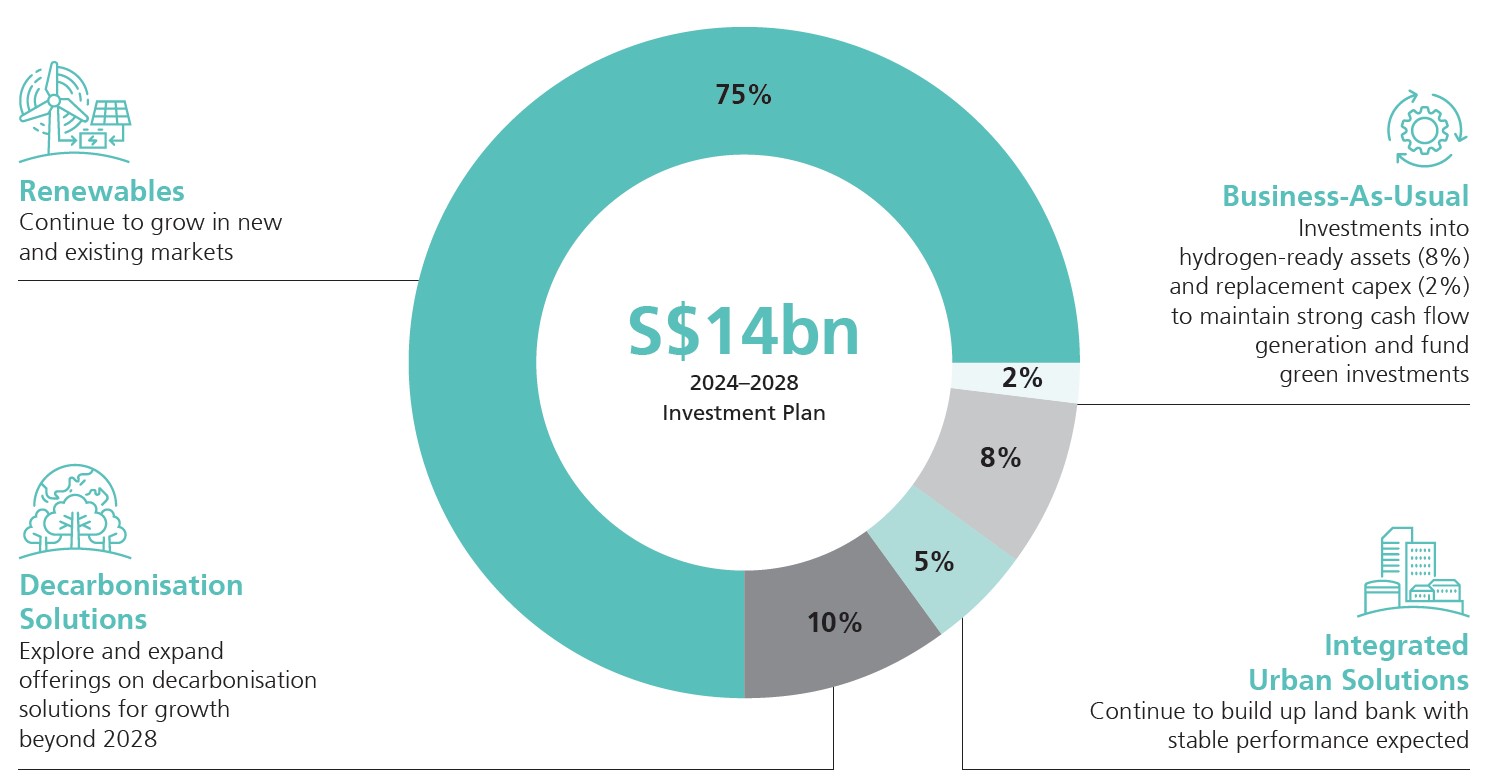
Capital allocation
Following the announcement of the proposed acquisition of Alinta Energy, information related to our strategic growth, capital allocation and financial target will be updated at our next Investor Day in 2026.
Climate-related disclosures
We report our performance, activities and initiatives on climate change and other material sustainability factors in our annual Sustainability Report. Our Climate-related Financial Disclosures are guided by the recommendations of the Task Force on Climate-related Financial Disclosures (TCFD).
1 World Energy Outlook 2024 report
2 Gross installed renewable energy capacity refers to current capacity of the plant at commercial operation date (in megawatt alternating current for wind and solar, and in megawatt-hour for energy storage) as specified in the grid connection agreement or as permitted (assumes 100% ownership of the facility). Figure excludes acquisitions pending completion and projects secured or under construction
3 GHG emissions intensity refers to the Group’s total GHG direct emissions (Scope 1) from its activities, indirect emissions (Scope 2) from its energy consumption and biogenic emissions from bioenergy feedstocks, divided by total energy generated and purchased, as calculated using an equity share approach for all operations in accordance with the GHG Protocol
4 The 2035 emissions intensity target was developed with reference to country-specific well-below 2⁰C trajectories and will be externally assured. Further information on our Climate Action Plan will be provided in our Climate-related Disclosures published together with the Sustainability Report 2025
5 2050 target cover the Group’s absolute Scope 1 and Scope 2 emissions